
Serving as an indicator of the looming threat of ignorance —The Ghanta Ghar
- Maham Waqar Jhagra
- Nov 10, 2021
- 4 min read
Updated: Dec 8, 2021
Just like the city of Lyallpur, The Clock Tower is getting weaker day by day from the inside. After losing its strong cultural diversity, only Faisalabad remains, Lyallpur has vanished long ago!
Lyallpur city is a name not known to many in today’s Pakistan. Why would it be known, anyway? A name not mentioned is a name unknown, simple as that! The disappearance of the name “Lyallpur” is a clear reflection of the culturally dwindling country that Pakistan is!
Beginning with Lyallpur’s history, it was a city which was famous for its cultural diversity and religious harmony. Before partition, Sikhs, Muslims, Hindus and Christians would all live together in this place freely practicing their religions and cultures.
A very renowned monument of the British Raj in this city which still stands upright is the Clock Tower or the Ghanta Ghar. It is not the first one that was built in the city of Lyallpur rather it is the second one. The first one was built for many purposes such as telling time, gathering people to communicate important messages etc. What led the British to build the second Clock Tower and why it is more famous than the first one is that Muslims protested that the tower only represented the Hindu community. Thus, the British then convinced the Muslims to collaborate with the Sikh, Hindu and Christian communities to build another Clock Tower which represents all the communities equally. Thus, it can be said that the current Ghanta Ghar is proof of the plethora of cultures that once prevailed in the city of Lyallpur.

The Ghanta Ghar stands in the centre of 8 markets; all leading in different directions. It can be seen from the end of each market.
There are hundreds of streets interconnecting all of the 8 markets around the clock tower. These streets are known for being sprinkled with mosques, churches, temples and gurdwaras. Unfortunately, majority of the churches, gurdwaras and temples have been turned into schools or other institutions. Some have either been demolished or totally cut off of the streets due to sprawling shops blocking their entrances. The remaining have collapsed because of negligence.
Similarly, little heed is paid to The Ghanta Ghar’s renovation. From the exterior, other than a few cracks in the plaster on the pillars and the slightly broken railing, it is in good shape. However, its interior is not in a very stable condition. The roof has become a bird nest and pedestals inside the tower are eroding away.
Just like the city of Lyallpur, The Clock Tower is getting weaker day by day from the inside. No matter how strong its foundations are, if nothing is done to improve its deteriorating condition, one day, it will fall to the ground and its existence will vanish into thin air just like the city of Lyallpur. Then, although the tower’s remains would still be there, it would be invisible to the people as it would have lost its essence, just like the city of Lyallpur did. After losing its strong cultural diversity, only Faisalabad remains, Lyallpur has vanished long ago!
After partition, when many Sikhs, Hindus and Christians migrated from the country, with the passage of time, with religious extremism increasing at a tremendous rate, the minority religions were pushed back until they were out of sight. As a result, what is left now are only traces of other religions. Hence, only traces of other cultures!
Sadly, very few people can grasp the complexity of this alarming situation. In the decreasing religious and in turn cultural diversity in the society, these people can see the image of the utterly ignorant society that the Pakistani society is turning into. Ignorant in a way that with only one culture and one religion, the society will lose the multiple perspectives that it previously had. Slowly and gradually, it will only look at everything from a single lens. Then, a time would come that they will not even realize that the lens through which they are looking at the world is not intact anymore and even if they know, they will not have any choice!
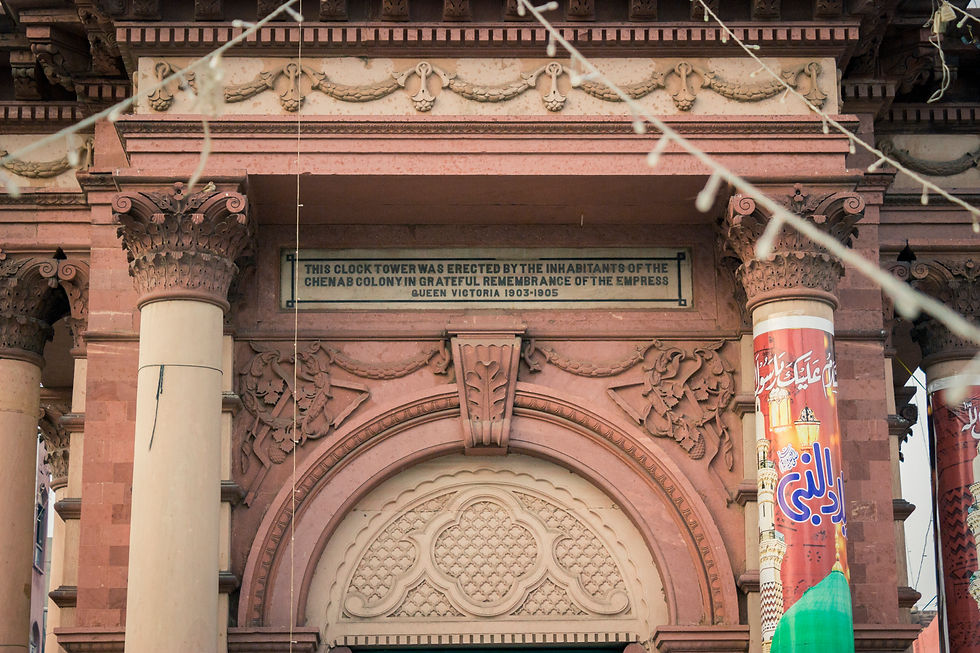
“This Clock Tower was erected by the inhabitants of the Chenab Colony in Grateful Remembrance of The Empress Queen Victoria 1903-1905”, is inscribed on plaques on all four sides of the tower in 4 different languages: Hindi, English, Urdu and Gurmukhi.

“Gone are the days when it was a Gurdwara, it is a school now”, replied a 50-year-old Sikh woman when asked about The Gurdwara Singh Sabha’s location. On further inquiry about why it was converted into a school, she sarcastically responded, “Perhaps, the Government has run out of land. After all, Pakistan is too small to fit in Gurdwaras.”

The Gurdwara Singh Sabha is now known as The Government Pakistan Model High School. It is located between the Katchery Bazaar and the Rail Bazaar.

“If only a window into the past could be opened and the Sikh culture could be brought back to Pakistan in all its might and main”, sighed a Sikh shopkeeper who refused to disclose his identity.
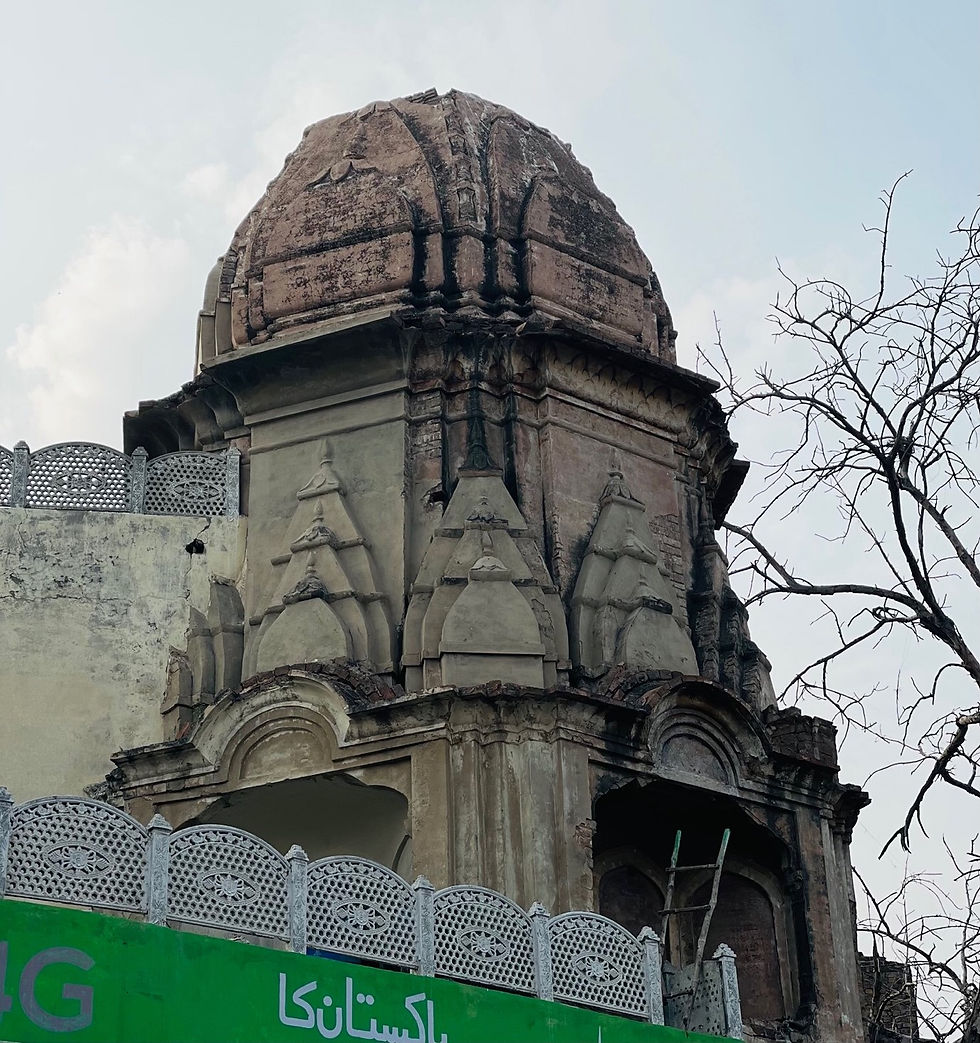
'Beta, there is no way inside. Only what you can see is what is left of the temple' , said Shehryar Alam, a 45-year old local, when I was trying to find a way inside the temple.

The First Presbyterian Church, just like the closed doors of this church remain closed any hopes of its renovation!

Why is the Kalma written on top of the Clock Tower when an inscription in Urdu is already there to represent Muslims?

On top of the Famous Jamia Masjid Ghousia Rizvia, in the exact centre, a flag has been hoisted. When 10-year-old Ali who was just leaving after offering his prayers, was asked about the reason behind it, he said, “Pakistan is a Muslim country. Obviously, there has to be a flag on the roof of every mosque!

Has Pakistan always been “only” a Muslim Country? Why are there no flags on Gurdwaras, Temples and Churches when all are situated on the same motherland?

The Islamisation of the Ghanta Ghar and the decline of Temples, Churches and Gurdwaras serve as a stark reminder to the Pakistani nation that the society is being robbed off of one of its sheerly valuable characteristics; its cultural diversity!

The Clock Tower’s intact exterior but unstoppably withering interior begs the society to look below the surface, to try to grasp the abstract threat, when it still can!


Great and entertaining read!
Very interesting & informative article!! 💯