
The Sun of the City of Saints - Shah Shams Tabrez
- Irtabat Nasir
- Nov 1, 2021
- 3 min read
Updated: Dec 8, 2021
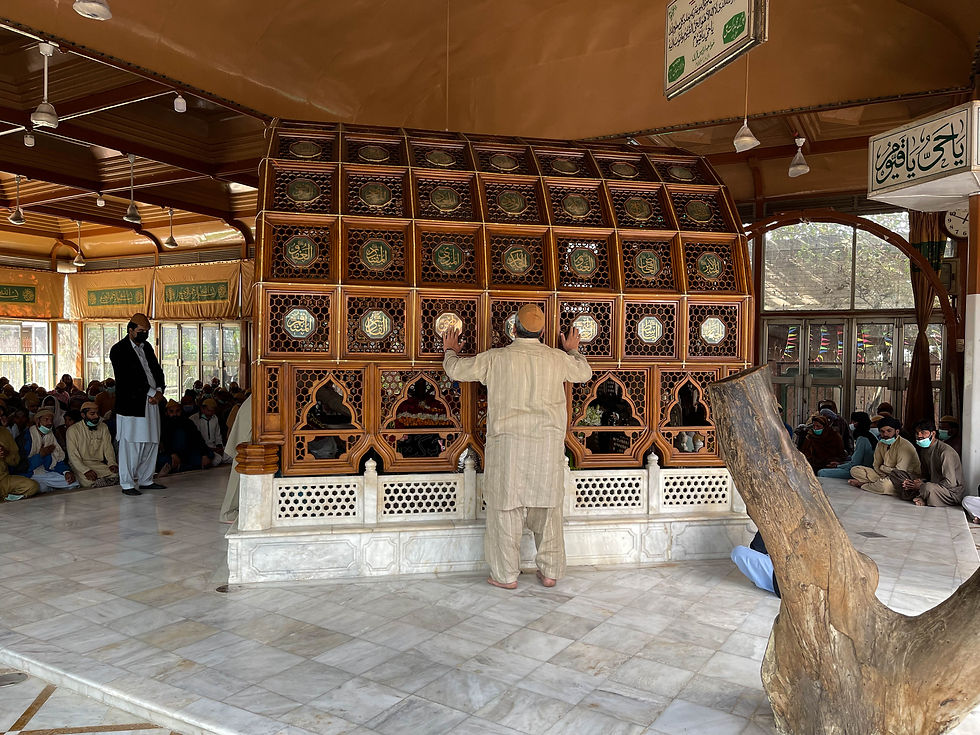
People are seen holding their hands on to their faces, eyes shut, asking for God to grant them the wills of their heart for the sake of the ‘Wali’ laying to rest right there. There is an aura of peace and silence when inside. A smell so soft yet unrecognizable, probably that of flower petals scattered all throughout. Love, they say it.
Just the mere mention of Multan brings into mind the dazzling dome of the Shah Rukne Alam shrine, that has remained the face of Multan for as long as history has seen. But the story does not of course end here. A soil so rich, it once drew big names like Lal Shahbaz Qalandar, Bahauddin Zikriya, Syed Jalaluddin Bukhari and Baba Farid-ud-din Ganjshakar towards it. Thus, Madina-tul-Auliya – the City of Saints, for a reason.
They say that one droplet on its own, has no value. But once that it joins the sea, it gets known as to being part of the sea itself. The very same way, letting go of yourself and finding solace in your Creator is what gets a person to be known. Amongst the very blessed people having reached this stage and to be remembered by times to come, is the name of Hazrat Shams ud Din Tabrezi Sabzwari.
'Since the very start of his life, he was fond of the darkness and enjoyed his own company' , says Tariq Shamsi the caretaker of the shrine. 'At an age very young, he mastered in studies like that of the heart, the stars, the palms, the djinns and many more. It was only at the mere age of 16, that he began answering questions of all who asked through the Holy Quran. This knowledge was something that he carried in his blood and lived up to the prediction of his grandfather, sufficing to the queries of millions.'
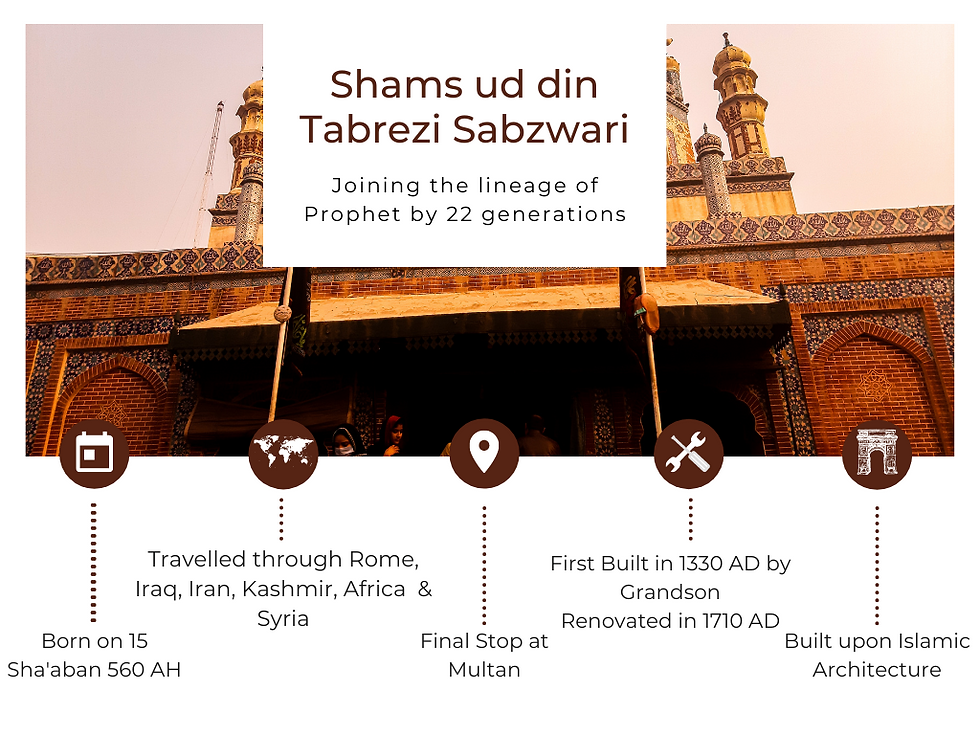
After going through a series of checking, one enters the shrine to be seen by two or mostly three men, settled on the ground. One for collecting your shoes, and the other two, qawwals. Saying verses out loud in the love of God, the Prophet and his kin, people often stop by to either sit and enjoy or else hand them cash for the rhythmic environment that they sit having created.
Shrines are a love language. Few tend to listen to, and even fewer getting to understand it. The shrine of Shah Shams witnesses people sitting with blank expressions, staring into nothingness. With flags fluttering up high, it is interesting to note how people distressed of the world tend to find solace in the compounds of those close to their Creator.
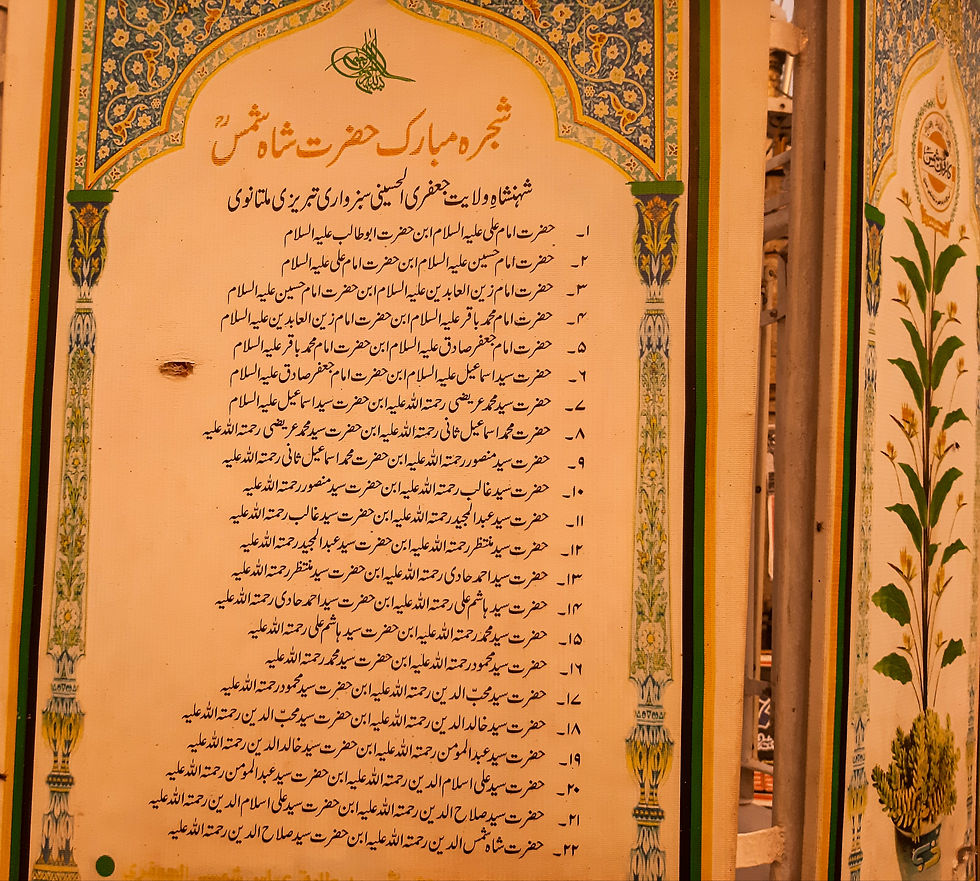
The pedigree of Shah Shams Tabrez, put to display at the very entrance of the shrine. Joining the lineage of the Prophet (saww) by 22 generations, the world knows him as Shah Shams Tabrez.

Stalls lining the alley leading to the shrine. Visitors take away chaddars to lay on to the grave or else tabarukaat as a memory of having come here, on their way back.

Towards the right side of the alley, there are special circles amidst the ground, dedicated to hoisting the Black Flag, top and high, surrounded by many little ones. 'Whatever time of the day it is, this point is never short of visitors' , adds Shamsi.

The left side has the MajlisKhana. Gatherings all around the year, and especially those in Muharram are held therein, a space wide enough to accommodate many.
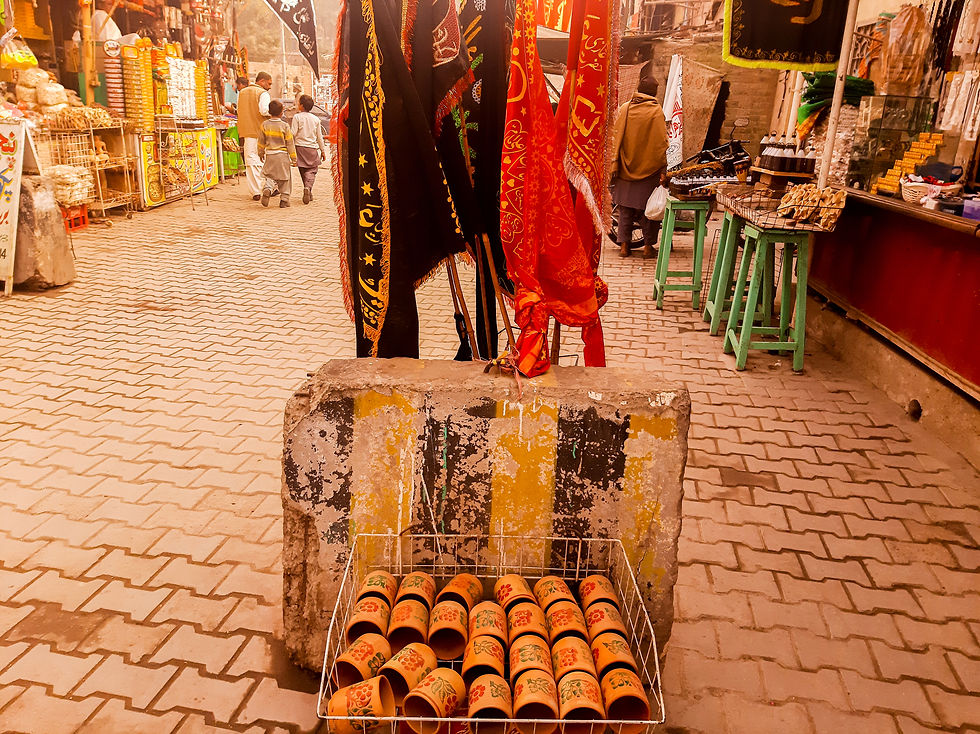
Decorated pieces of pottery placed on the entrance with a few flags by the side. Said to be in the memory of those thirsty in Karbala.

One man sits collecting the shoes of the visitors, the other is a qawwal attracting people with his voice. That moment his chants were that of the very famous qawwali ‘Nabi Aey Asra qul Jahan da.'

Leaving the small room and climbing three steps downwards, one is greeted by another courtyard and the magnificent shrine on top of it. The centre of the ground hosts yet another Black Flag that they call the ‘Markazi Alam.’

The entrance to the shrine is right in front of the Markazi Alam. Just outside the gate of the hujra, there sit men giving off ‘chaddars’ to people wishing to put onto the grave.

Another man sits with trays of oil lamps – diye – that people choose to light when asking God to answer their prayers for the sake of the saint. Lighting one after visiting the saint they say, fulfills one’s desires.

Some move towards tying a cloth – mannat – around one of the very old trees present in the courtyard or else on to the windows of the shrine, again in the hope of getting their prayers answered.

The white-tiled mosque in the courtyard, subjected to the setting sun. Sounds of qawwali emanating from near the entrance, seem to as if blur in the background. You understand what silence is. You realize it is love.


Comments