
The Burial Site of a Multicultural Past - Haveli Sujan Singh
- Irtabat Nasir
- Oct 22, 2021
- 5 min read
Updated: Dec 8, 2021
While Partition talks always end up being about Lahore, we often tend to ignore Rawalpindi that too had as multicultural a history as the former. Ramshackle Hindu and Sikh mansions stay hidden in the busiest bazaars of Rawalpindi and might also perish without the majority even ever knowing.
After having crossed the overcrowded marketplace and taking a number of turns within the streets, one ends up right in front of a prominent remnant of Rawalpindi’s multicultural past – the Sujan Singh Haveli. Rai Bahadur Sujan Singh as to being loyal to the British, was known to be a man of culture and the Haveli, today a century and a half later, is one living proof of the statement.
The alley leading up to the Haveli and also quite actually passing through it now, is narrow enough for not more than two people walking through it simultaneously. The component that one sees on their right is far more destroyed and barren as compared to the other, with no access allowed inside the gate that probably is the only standing piece of structure it has. The two portions were reportedly said to be connected by a steel bridge that again shows no signs of having ever existed today.
The veranda, looked down upon from all the floors, is a rectangular piece of land connected to rooms from all four corners. Boasting intricate carvings and airy verandas, the rooms once were a sight to behold. The four storeys are connected via a magnificent staircase that holds wood and ivory embellishments up to the very top. Iron embellishments therein were supposedly imported from the United Kingdom in the 18th Century and formed the foundation of most of the work.

What is highly interesting is the fact that 7 huge mandirs can be spotted from the top of the Haveli, let alone many smaller ones too. It can be judged easily how they’ve been through wear and tear, bearing onto themselves reflections of a culture long buried with time. The Mohan Temple for example, now stands breathing a few of its last, with having turned all black from the outside. Today, a Muslim family inhabits the premises of the temple and does not receive many visitors, except for on special Hindu festivities.
Many other domes are seen looming over the marketplace, rising over homes and amidst busy lanes. Most of them having breathed their last or on the verge to, but either way on the road leading to fall.
The tragedy of the Sujan Singh Haveli is just one example of how dilapidated the condition of heritage sites in Pakistan is. Worse is the fact that they remain hidden from the eyes of majority, burying themselves into the ground with time. The mansion that once carried stories of grandeur and profligacy, has now become home to bats, cats and all sorts of insects. One look at the collapsed roofs and termite-ridden walls, one is reminded of how our heritage is there crumbling right in front of our very eyes.

Once part of the Haveli, it now sits apart from the gates. A grand courtyard in good days, it was said to have fountains which show no signs of existence today. In one corner, there is a well that is reported to be functioning to date. At that time, families from the surrounding areas would come to visit the mansion and carry back pails full of water.
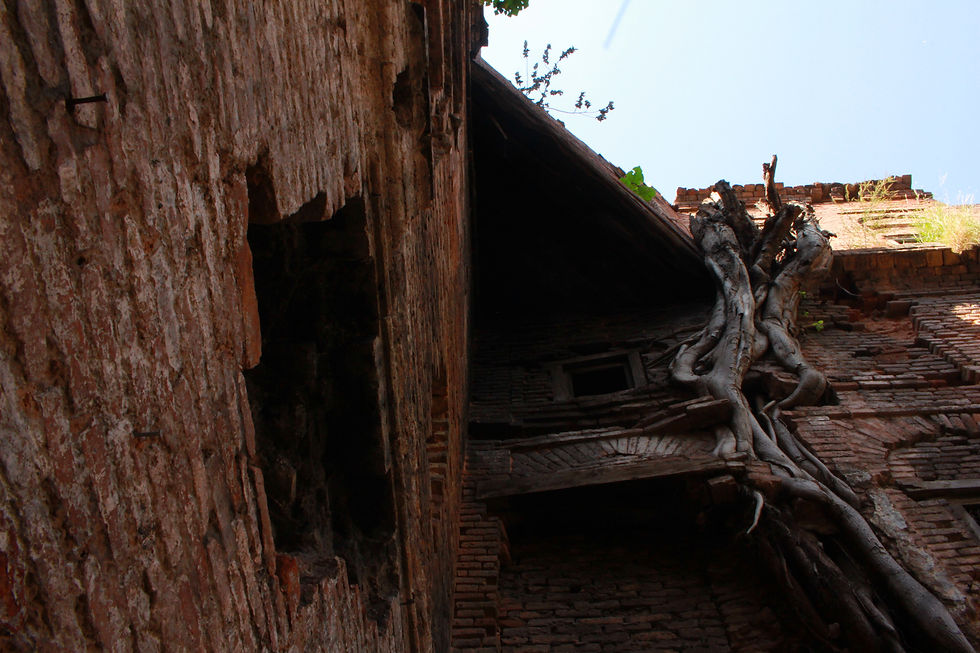
A tree the age of the Haveli, is one witness of all the occurrences in the last century and a half. Amazing how it has its roots interlaced and buried deep with the remnants of the Haveli.
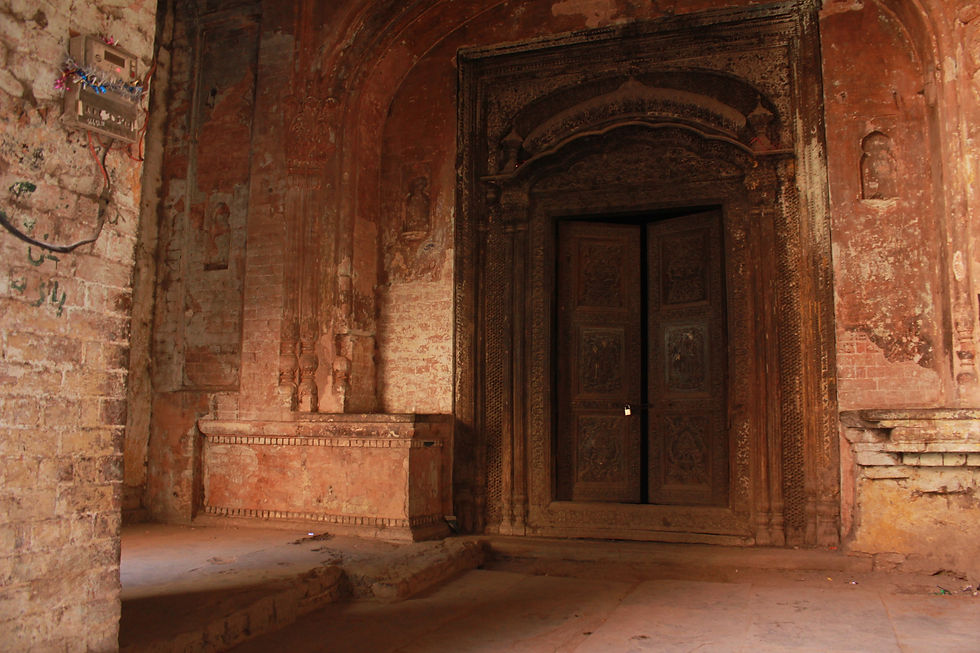
The grand opening to the Haveli that once was a passageway for nobles and courtiers, now stands locked, yet the aesthetic remains. The door opens into an entrance hall that leads into a huge veranda, the centre of the entire Haveli.

Ancient Theologians believe that illegitimate love is selfless and given freely as compared to married love. This is what forms the basis of Radha and Krishna being imprinted on the door of Haveli Sujan Singh.

A man nearing the end of his life, sits guard to the Haveli since the last 7 years. ‘When I first came here, the interior was way better. Glass doors stood still and wooden floors not as squeaky. Oh and these were not there too’, he added just as a rat, the size of a hedgehog, ran by.

The walls were once held images of Sujan Singh’s ancestors, who were said to be courtiers in the times of Maharaja Ranjit Singh. As of now, they stand barren with random inscriptions done by local Pakistanis, caring no less of how these walls were once adorned with stuff worth way more than their entire existences combined.

Back then, peacocks would often be seen parading the hallways. To see for now, the very building seems to have withstood a series of robberies, a fire outburst, continuous negligence and what not.

The forsaken Diyar woodwork from the 18th century, now hosting more than a dozen of nests. Lit by huge lamps and exquisite wood chandeliers, the halls were adorned with Victorian style furniture, separated from one another by glass doors. But the creaking wooden boards of what was once a grand ballroom, now stand bare of precious murals and void of visitors. Just too bad to see.

From the rooftop of the Haveli, one is provided with a panoramic view of the city. Domes of masjids, mandirs and gurdwaras peek from amidst billboards, rising high above the busy markets. What is highly interesting is the fact that 7 huge mandirs can be spotted from therein, let alone many smaller ones too.

Rising from amidst her courtyard, the woman of the house is habitual of receiving visitors for the temple. 'Chinese and Koreans are the most frequent but Hindus visit only for their specific occasions' , she said. 'Oh and this one time a Chinese asked me to give up my Tashbih beads and instead start reciting the bible. Ridiculous!' , she added offering a toothless smile.

The Bagh Sardaran Temple Complex hosting a number of mandirs and gurdwaras, all blackened and withered. One of a kind during their time, they now seem on the verge of falling prey to death looming right above them, taking to ground both the Mughal architecture and Hindu cultural depiction, soon.

Coming in the vicinity of the Sujan Singh Haveli, the temple complex has his very name engraved onto it. The 75-year old closure that this compound has been through, has molded it into being more of a ghost house.

The Haveli once had a cave that led to Bagh Sardaran, which has now caved in and left back nothing but ruins. Not far from when the haveli too reaches the same end.


Comments