
An epitome of the Sikh Community’s historical dominance in Peshawar -The Gor Khatri
- Maham Waqar Jhagra
- Nov 26, 2021
- 4 min read
Updated: Dec 26, 2021
The Sikh community has been living in Peshawar for a long time. Even during partition, when due to cultural violence, most of the Pakistani Sikh community migrated to India, the Pathan Sikhs stayed back because they were given protection by their Muslim Pathan brothers.
It is common talk that the Sikh Community in Peshawar follows the Pathan culture instead of the Punjabi culture which is originally associated with Sikhs all over the globe. They are fluent in Pushto and live blended in the Pathan community.
Little heed is paid to the cause of the pre-eminence of the Sikh community in Peshawar as compared to other minority groups such as Christians and Hindus. Why are the latter two groups not considered as a major part of the Pathan community in Peshawar? The answer to this question lies in the historical roots of the city. The historical site of Gor Khatri is one of the few landmarks in Peshawar which adds a great part to this answer.
The Gor Khatri meaning the Warriors’ Grave, is a symbol of the multicultural history of Peshawar like many other historical sites in the city. However, it is among the very few which give one an insight into the historical dominance of the Sikh culture in the city. The Gor Khatri is situated in the heart of the old city of Peshawar. Initially, it was a sacred place for Buddhists. Then, it became a hub of religious activities for Hindus. The site was well known for training Hindu priests in the philosophy of yoga. After that, when the Mughals realized the importance of Peshawar’s location for trade, The Gor Khatri was converted into a caravanserai (a resting place for traders) by Shah Jahan’s daughter, Jahan Ara Begum. The Mughal rule marks the first time when mosques were built at the site. In addition to this, 2 huge gateways were built on the eastern and western side of The Gor Khatri because of which it was known as “Sarai Do Dar” or “The Inn of Two Gateways”.
Moreover, when the Sikhs completed their occupation of Peshawar, they razed The Shahi Mosque, built in 1641 AD, which was located in the centre and replaced it with The Gorak Nath temple. The temple is built in the memory of Gorak Nath, a Hindu religious leader. They converted The Gor Khatri into the residence and official headquarters of their mercenary general, Paolo Avitabile, who served as the governor of Peshawar. The Sikhs were the only ones who used The Gor Khatri to showcase their martial strength and solidarity. They were also the only ones who demolished a mosque and constructed a temple in its place, the biggest building in The Gor Khatri, exhibiting their cultural and religious superiority in that era.
The British Raj used the Gor Khatri as a fire brigade office in 1912. Now, the Gor Khatri is used as a public park.

The Gorak Nath temple is the most prominent building in The Gor Khatri park and still drags one into the majestic past of the Sikh rule in Peshawar. It is used by the Hindu community for a plethora of religious activities.

Gul Sher, a 45-year-old local at the park, said. 'To enter, one has to take his/her shoes off out of respect. In the olden times, it was also mandatory to wash one’s feet in the rectangular pool of water at the entrance. However, it remains empty now.'

The temple has been painted rubicund and white. There are rooms at the front for pilgrims from faraway cities. The Hindu sacred symbol 'Om' can be seen above the door of a guest room.
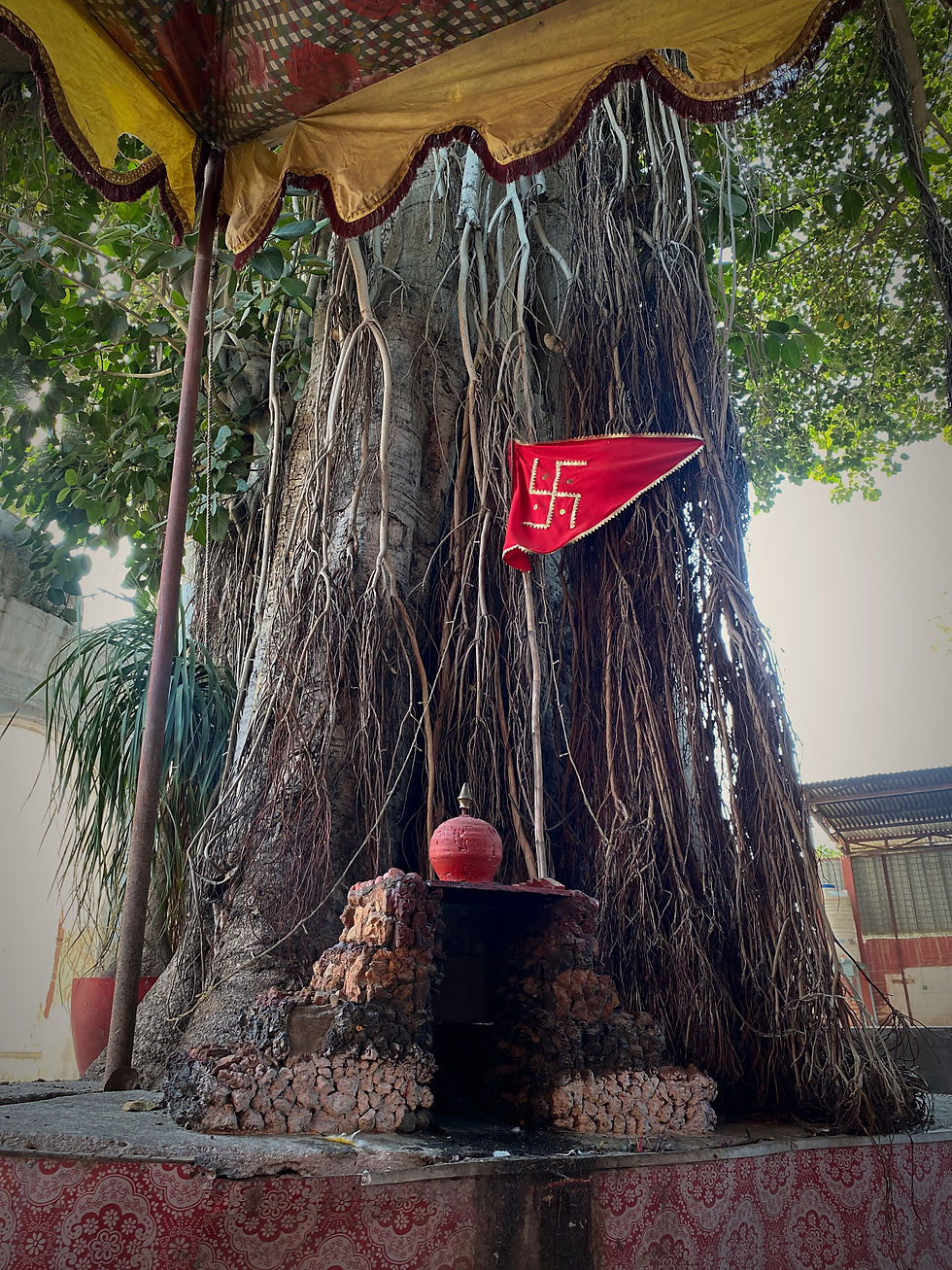
Infront of the fig tree in the temple, the Diwali pooja is held every year. The place is also said to be haunted, by the locals. A police constable who had been posted there to provide security to the Hindu community during Diwali celebrations this year, said, 'This place is terribly haunted. We have not been able to sleep at a stretch for the past 6 days, so we are trying our best to get transferred as soon as possible.'

In front of the Goddess, a pooja (ceremonial worship) and the ritual of Kundli Milan or horoscope matching for marriage are performed. It is to check how the stars influence the couple’s marriage and provides remedies for eternal bliss. The marriage date is also fixed according to the horoscope.

In the olden times, the Naag Devta (the snake which is carried by the Hindu Lord Shiva around his neck) used to be worshipped here. The Naag Devta would sit entwined on the top of the stone called the Shivling and he would be bathed in milk which would flow from the steel pot hung above it, as part of the ritual.

Through an underground canal, the milk would flow into this well and be dissolved in the water. Ahmad Saeed, the guide told us, 'Now, the pooja is performed without the Naag Devta, only the Shivling is bathed with milk.'

Just in front of the temple’s entrance stands The Masjid Imam Abu Hanifa which has been built recently.

The magnanimous and magnificent Western gate which opens into The Mohalla Sethian once served as a resting place for the governor of Peshawar who was the Sikh army’s mercenary general, Paolo Avitabile. Currently, it is under renovation.

A sign of the British rule is also present on one side of the park; Fire Brigade Municipal committee Peshawar. Some parts of the building have been reconstructed while others have faded away.

Beside the eastern gate, to the left side, lies a gigantic trench, an excavation site. The digging was begun to discover precious artefacts which have been buried below the surface, thousands of years ago.

In conclusion, within the four-wall boundary of the Gor Khatri, through the eastern and western gateways, the fire brigade building and the Gorak Nath temple, a mix of cultures can be seen. However, there are two distinct features solely relished by The Gorak Nath temple, an epitome of the 'Sikh' rule i.e. its central location and its largest size, serving as proof of the dominant mark that the Sikh rule has left on the city of Peshawar, which still prevails.


Comments